The Counterfeit Kingdom
Exposing the Prosperity Gospel, the Seven Mountain Mandate, and the Babylonian Blueprint Behind Them

Have you ever looked back on something you were part of and realized it was nothing like what you believed at the time? You went looking for truth and, instead, found manipulation. You went looking for light. What you found was darkness. You end up asking yourself how you didn’t see it. You tell yourself you should have known better. That’s exactly what I experienced with the Seven Mountain mandate (7MM) and the prosperity gospel.

Both movements ended up hooking me with promises of calling, purpose, influence, and destiny. Both used Scripture fluently and confidently. Even convincingly. They talked about “Kingdom impact,” “bringing heaven to earth,” and “walking in God’s authority.” For a long time? I believed it. I never thought to question it because the people teaching it seemed passionate, spiritual, loving, and sincere. They believed they were doing God’s work. I believed I was, too. And I was. Just not in the way I expected.
Eventually a question surfaced. A question that fully broke the illusion. If Christians were meant to take control of culture, government, and earthly power before Jesus returns, why didn’t Jesus tell His disciples to take over Rome? That question wouldn’t go away once it fluttered in my heart and mind. Something stirred in my soul. The more I wrestled with it, the more the patterns became clear.
The Seven Mountain Mandate and the prosperity gospel may look different on the surface, but they grow from the very same spiritual root. When you follow the thread all the way through, you reach the same conclusion. Both of these movements twist Scripture just enough to shift the focus from surrender to self-exaltation and idolization. It shifts the message from truly following Christ to a message that encourages the pursuit of influence. It shifts the message from calling followers to carry their cross to a message of calling them to climb a ladder.
These people never deny Jesus. They use his name very, very frequently. Oftentimes with tears in their eyes. What they don’t understand (perhaps) is that they are actually trying to reposition Him. They don’t position Him as the King who reigns and returns. They position Him as the key to unlocking earthly success, authority, and status. Once you see it? You can’t unsee it.
What the Seven Mountain Mandate Claims
Before I ever questioned it, the Seven Mountain Mandate sounded like a solid mission. It felt purposeful and strategic. It felt like finally I had found the way that Christians work to change the world.
When you’re introduced to 7MM, the message goes something like this…
If believers can rise to the top of seven key areas of society (government, media, education, business, family, religion, and arts/entertainment) then culture will finally reflect the values of the Kingdom of God and once Christians hold influence over these “mountains,” then righteousness will spread, darkness will retreat, and society will be magically transformed.
It wasn’t presented as pride. It was presented as obedience. It wasn’t presented as ambition. It was presented as assignment. It wasn’t presented as human strategy. It was presented as “God’s blueprint to reclaim culture.” And that is how deception works. It doesn’t just walk into the room wearing horns. Sometimes it walks in holding a Bible and quoting Scripture.
I found the promises to be compelling. “God wants His people in positions of influence.” Sounds good. “Christians should lead culture, not hide from it.” Sounds great. “We’re called to advance the Kingdom and not retreat from the world.” Well I agree. And it sounded bold and fearless. What it sound like? To me? It sounded like faith. Underneath it, however, was a subtle shift that I didn’t catch at first.
The focus wasn’t on making disciples. It was on taking territory. The focus wasn’t actually about preaching the Gospel. It was about gaining control. Slowly, almost imperceptibly, the mission stopped being about Christ’s authority. It became about theirs. About mine. And I realized once it was about me? It couldn’t possibly be about Him.
I will be clear. The heart of the Seven Mountain vision isn’t that Jesus will rule when He returns (and He WILL rule). The message is that Jesus can rule if we take over now. And that is a familiar message rooted in pride.
The shift that I saw happen, the shift from dependence on Christ to reliance on human strategy, is where the cracks started to show. It’s where I saw that the same spirit that fuels the prosperity gospel blends seamlessly into dominion theology. Yes, there’s a different vocabulary but it is the same DNA. And 7MM, the prosperity gospel, and every false teaching is spreading the antichrist spirit today. They offer believers something Christ never promised. They offer a seat at the table (a table we should be flipping by the way) and a role at the top. They tell us to search for a crown before the Cross.
The question that eventually confronted me head on was simple. So simple I really couldn’t ignore it because there is a very clear answer. If this vision were really a mandate from God? Why didn’t Jesus teach us it? Peter never taught it. Neither did Paul. None of the apostles’ writing does. The early Church didn’t pursue it. The more I searched Scripture, the more I realized the glaring silence. Scripture doesn’t give us instructions on seizing power from culture. It doesn’t give us a blueprint for infiltrating political thrones or structures of culture. It never gives us a mandate to “take over” anything. If anything, we should GIVE. We spread the true Gospel. That realization led me to a truth I had wish I’d recognized much sooner. Sometimes the most dangerous of all teachings are the ones that are built from Scripture that is taken out of context.
The Prosperity Gospel Connection and Seeing the Same Lie with Different Clothing
Before I had ever even heard of the Seven Mountain Mandate, I was already familiar with another message that carried similar energy. The prosperity gospel. At first glance the two seem like separate doctrines. One is focused on culture. The other on the individual. Once you strip back the language, however, and the emotional appeal, you soon realize they are built upon the very same spiritual blueprint. Both promise elevation and breakthrough. Both promise visible success in this life. Not endurance, not holiness, not suffering, and not sanctification. But worldly results. Both movements claim those results are real evidence of strong faith. Scripture becomes a currency and prayers become transactions. Obedience becomes a pathway to achievement rather than surrender. In the prosperity gospel, blessing is measured by what you have. Income, comfort, stability, abundance, increase. In the Seven Mountain Mandate, blessing is measured by where you stand. Platform, influence, visibility, leadership, cultural authority.
One message says, “God wants you wealthy.” The other says, “God wants you in power.” Both whisper the same underlying promise. “You were meant to rise.” In both, the Cross stops being the center. Instead of being called to die to ourselves, we are told to build something for ourselves “for the Kingdom.” Instead of following Christ wherever He leads, the emphasis becomes applying principles, strategies, declarations, and positioning so we can achieve the outcome we want. The cross becomes a ladder. Faith becomes a formula.
And yet, Jesus never said, “Follow Me so I can elevate you.” He said, “Whoever wants to be My disciple must deny himself, take up his cross, and follow Me.” (Matthew 16:24) The prosperity gospel and the Seven Mountain Mandate don’t reject Jesus. They hijack Him and redefine Him. They turn Him into a stepping stone rather than the destination. He is treated like a method rather than the Master. They forget He is the King it seems. They promise power now. Promotion now. Victory now. But the Gospel doesn’t call us to climb. It calls us to kneel.
The Babylon Connection and why the “Seven Mountains” Aren’t Holy
I first heard the Seven Mountain language used at a networking group I had joined. I actually ended up volunteering for them. The language sounded familiar and I assumed it had come straight out of the Bible. It definitely sounded biblical and authoritative. The phrases were repeated so often and so confidently that questioning anything in the message seemed almost blasphemous at times.
Why my eyes had been blind to what had been clearly going on in what I was involved in was beyond me when they were finally opened. I didn’t know how I couldn’t have seen it to begin with. I was born again. I should know better. I admittedly didn’t even know the 7 Mountain Mandate was a movement, a “thing”, until a dear friend told me about it. I screenshot the “seven mountains” slide from the networking group’s monthly presentation and sure enough, it was exactly what she was talking about. And there is a reference to the seven mountains in the Bible. But it’s definitely not a mandate for the Church. It’s a stark warning.
Revelation 17:9 says, “Here is the mind which has wisdom: The seven heads are seven mountains on which the woman sits.” The woman in this passage isn’t the Bride of Christ. She’s Babylon. The symbolic representation of a corrupt global system marked by seduction, power, wealth, influence, political control, idolatry, and spiritual compromise. Babylon represents the final expression of humanity’s rebellion. It isn’t a country. It is a world system that is intoxicated with influence and obsessed with power. It looks spiritual. It looks impressive. It looks successful and influential. The problem is that it is built upon pride and it is headed for judgment. So, please, if you are attracted to these messages, pause and let this land…
The only time God mentions seven mountains in Scripture? He isn’t commanding believers to rule them. He is revealing the structure of a counterfeit kingdom destined for destruction. The Seven Mountain Mandate claims those mountains are our assignment. They are our blueprint for cultural conquest. The Word of God, however, says that those mountains are a warning. A map of a spiritual system that believers must refuse, resist, and separate from.
The Bible never assigns seven mountains to the Church. It assigns them to Babylon. The kingdom Christ destroys. And that’s where the sobering reality comes in.
Instead of reflecting Christ’s pattern of servanthood, humility, suffering, and witness, the Seven Mountain strategy unintentionally mirrors the architecture of Babylon. It mirrors the very empire God calls His people to flee, not build.
Revelation 18:4 is not gentle. It is not optional. It is not vague. It says, “Come out of her, My people.” Not climb her. Not conquer her. Not claim her mountains. Come out.
The Kingdom of God? It doesn’t come through worldly power. It doesn’t come through cultural dominance. It definitely doesn’t come from strategic takeover. It comes through Christ, and Christ alone.
When the Gospel Is Altered, God Calls It Accursed
It’s one thing to use Scripture out of context. It’s another to reshape the entire message of Jesus into something He never preached. The prosperity gospel and the Seven Mountain Mandate don’t openly reject God. The do, however, change His message. And it may seem innocent enough, but according to Scripture, that is not a small error. It is spiritual treason.
Paul told us in Galatians 1:8–9, “But even if we or an angel from heaven should preach a gospel other than the one we preached to you, let him be accursed. As we have said before, so now I say again: If anyone preaches a gospel different from the one you received, let him be accursed.”
Paul doesn’t soften that language. He doesn’t call a distorted gospel “a different perspective,” or “a fresh revelation,” or “a new strategy for the Kingdom.” He calls it accursed. Why? Because once the Gospel is changed (even slightly), it stops being the Gospel.
The true Gospel is about Christ’s lordship, His sacrifice, His authority, His return, and our surrender to Him. A counterfeit gospel makes room for things like human ambition, personal advancement, earthly reward, spiritual entitlement, and cultural dominance. The prosperity message adds wealth. The dominion message adds rule. Both add something Jesus never promised and, in doing so, both subtract the Cross.
This isn’t just a doctrinal disagreement. Scripture warns that twisting the Gospel is a sign of deception in the last days, not revival.
“For the time will come when people will not endure sound doctrine, but will gather teachers to suit their own desires.”
— 2 Timothy 4:3
A modified gospel is not an upgraded one. It is a poisoned one. And God certainly takes it seriously. It is something that leads people away from Jesus while using Jesus’ name.
Why So Many Fall for Its Emotional and Spiritual Appeal
If the Seven Mountain Mandate and prosperity gospel are distorted messages, then the next honest question is, why do so many sincere Christians fall for them? Because I have met SO many sincere people in that “movement.” People who truly love God, but somehow miss this part of His message.
It’s not because believers are foolish, shallow, or spiritually blind. It’s because the deception is tailored to the deepest longings of the human heart. These teachings don’t prey on rebellion. They prey on one’s desire to be used by God. One’s desire for purpose and meaning in a chaotic world. A desire to believe that faith can change more than just our inner life and that it can shape the world around us. Those desires aren’t sinful. The deception becomes effective when it takes a right longing and attaches it to a wrong promise.
The prosperity gospel says, “God has more for you and you can access it if you activate the right principles.” The Seven Mountain Mandate says, “God wants influence for His people and you can fulfill prophecy by stepping into positions of power.” Both tell believers what they want to hear. That they are important, meant to make history, are a part of something big, and God is going to elevate them. And it does feel empowering. Purposeful. It is almost made to feel like destiny. Most dangerously? It feels like faith.
The thing is? Real faith doesn’t always feel like momentum. Sometimes it feels like waiting. Sometimes it feels like unseen obedience. Sometimes it looks like loss. Sometimes it looks like dying to things we wanted. Jesus never promised us significance in the eyes of the world. He promised us a cross. He never said we would lead nations. He said the world would hate us. He never said the Church would dominate culture. He said His Kingdom is “not of this world.” But the human heart? Especially the wounded, overlooked, ambitious, or insecure heart? It will always gravitate toward a message that promises visibility instead of obscurity, influence instead of surrender, elevation instead of humility.
This is why Paul warned Timothy, “For the time will come when people will not endure sound doctrine, but will gather teachers to suit their own desires.” (2 Timothy 4:3) It’s not merely bad theology that spreads these movements. It’s unmet longing. Unless we are able to recognize that longing and submit it to Christ, then a counterfeit kingdom will always look appealing. It promises what the cross requires us to lay down.
What Scripture Actually Commands
Once you strip away the noise of modern movements, prophetic branding, ministry marketing, and spiritual ambition, the Bible presents a shockingly simple assignment for followers of Jesus. Not glamorous. Not strategic. Not empire-building. It is clear. It is costly. Jesus did not leave the Church guessing. He told us exactly what our purpose is until He returns.
“You will be My witnesses…”
—Acts 1:8
We are not called to be rulers. We are not called to be influencers. We are called to be witnesses. We are called to be people who testify to what they have seen, heard, and experienced. Even when the world rejects them for it.
He did give us the Great Commission. But not as an expansion strategy. As a life calling.
“Go therefore and make disciples of all nations, baptizing them in the name of the Father and of the Son and of the Holy Spirit, teaching them to observe all that I have commanded you. And behold, I am with you always, to the end of the age.”
—Matthew 28:19–20
We are not instructed to build institutions. We are not instructed to seize influence. We are not instructed to establish a Christian world order. We are instructed to make disciples, teach obedience, and pass on the Gospel. And we are to pass it on unchanged, unpolished, and unaltered. The early Church understood this. They didn’t try to take over Rome. They didn’t run political campaigns. They didn’t strategize cultural dominance. They weren’t seeking seats at tables of power. They preached Christ. They broke bread. They prayed and they endured. They loved one another radically and sacrificially. They lived in holiness and repentance. And when persecution came? They didn’t interpret it as spiritual failure. They embraced it as evidence that they belonged to Him.
Jesus never said once said, “You will transform culture through authority.” He said, “In this world you will have trouble. But take heart — I have overcome the world.” (John 16:33)
The apostle Paul didn’t motivate believers to pursue earthly position. He reminded them, “Our citizenship is in heaven.” (Philippians 3:20)
Peter didn’t tell Christians to seek influence. He wrote, “Live as strangers and exiles.” (1 Peter 2:11)
The early believers didn’t view themselves as future cultural rulers. They saw themselves as ambassadors (2 Corinthians 5:20) representing a Kingdom that is coming. Not one that they were tasked with building with human strategy.
The true mission of the Church has always been to proclaim the Gospel, live holy, disciple believers, care for the poor and oppressed, reflect the character of Christ, remain faithful under pressure, and await His return with readiness. The motivation is simple. It’s not to rise, but to obey. Not to take control, but to remain loyal. Our calling is NOT to build a kingdom. It is to belong to the King.
The Kingdom we’re waiting for does not come through influence or dominance. It comes through the return of Jesus. The only One worthy to reign.
The Kingdom Isn’t Coming Through Human Strategy
One of the most dangerous assumptions behind the Seven Mountain Mandate and the prosperity message is the idea that we are responsible for establishing God’s Kingdom on earth. That it is our job to prepare the world for Christ by elevating ourselves into places of authority and influence. Scripture, however, paints a very different picture.
God is not waiting for the Church to take over systems of power. He is waiting for the Church to remain faithful while the systems of power collapse under His judgment. The Bible is clear about how the Kingdom arrives and it has nothing to do with cultural takeover or man-made influence. Daniel saw it…
“In the days of those kings, the God of heaven will set up a kingdom which shall never be destroyed…
It will crush all these kingdoms and bring them to an end.”
—Daniel 2:44
Not the Church. God. Revelation echoes the same reality.
“The kingdoms of this world have become the kingdom of our Lord and of His Christ.”
—Revelation 11:15
Not because we conquered the kingdoms, but because He returned and claimed them. When Jesus comes, He is not inheriting something we built. He is overthrowing everything man built. He is not taking a seat on a throne we established. He is taking back a world that never belonged to us in the first place. And here lies the contrast…
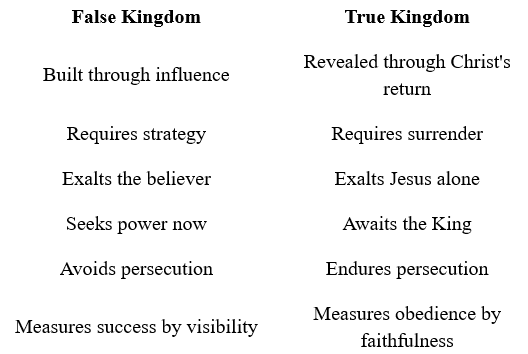
Every attempt that humans have made throughout history to create a Christian empire through force, politics, influence, or dominance has ended in corruption because you cannot build God’s Kingdom using Babylon’s blueprint. The early church understood this. They weren’t trying to create a Christian Rome. They were preparing for a returning Christ.
The Kingdom does not come because we master influence, climb cultural mountains, or build religious systems. It comes because the rightful King splits the skies. And until that day, our role is not to rule. Our role is to remain loyal. Jesus didn’t ask for a movement of conquerors. He asked for a remnant of disciples.
Returning to Christ and the True Gospel
When I finally stepped back and examined the Seven Mountain Mandate and the prosperity gospel through Scripture (not hype, not emotion, not leadership charisma), everything became painfully clear. These teachings didn’t point people to the Cross. They pointed people to themselves. To their calling, their influence, their elevation, and their so-called destiny. Both movements promised power, but they didn’t teach surrender. They promised advancement, but they didn’t teach obedience. They promised visibility, but they didn’t teach holiness. They promised victory now, but they ignored the cost of following Jesus now.
And somewhere in all the declarations, strategies, prophetic language, dreams of influence, and spiritual branding? Jesus was no longer the goal. He became the method. A means to personal or cultural success. A key and not the King.
But the real Gospel is not complicated. It has no ladder. No blueprint for takeover. No hidden “activation.” No seven-step formula. It begins and ends with one call…
“Follow Me.”
Not a call to follow ambition. Not a call to follow influence. Not a call to follow a movement. A call to follow Him. Even when it costs. Even when it isolates. Even when it strips away the very things these counterfeit teachings promise.
The truth is sobering. The prosperity gospel offers wealth Jesus never promised. The Seven Mountain Mandate offers authority Jesus never told us to pursue. And Babylon sits on seven mountains waiting for judgment.
God doesn’t need the Church to seize cultural power. He needs the Church to stay faithful. To preach the Gospel, make real disciples, love sacrificially, live holy, and endure until the end. We are called to keep our eyes on the returning King. Not the kingdoms of this world.
In the end, only one Kingdom will remain. Not the one built by influence. Not the one built by strategy. Not the one built by political dominance or spiritual branding. It will be the Kingdom that remains is the one Christ brings with Him. And on that day, there will be no competition. No rival empire. No shared throne. Only Jesus. His rule. His glory. His Kingdom.
We must return to the real Gospel. Not the upgraded, polished, rebranded version. The one Jesus actually preached. The message about denying ourselves, taking up our crosses, and truly following Him. Everything else is a distraction. Everything else is a counterfeit. Everything else is Babylon’s invitation disguised as strategy.
This is an invitation to those who can see it. “Come out of her, My people.”
The same trick when the enemy took our Lord to a very high mountain and promised Him all the kingdoms of the world and their splendor. Those people of 7MM know how to use pride to deceive many.
It seems obvious to me no (human regenerated in Christ should seek after power, authority over other people or prosperity. But there is a promise that if we seek God's kingdom and His righteousness some of those things the heathen seek will be added to us. If we are supposed to be the salt of the earth, the world will be under our influence somehow. We do not conquer, we serve, and the good servant obtains praise and promotion.
The person led by the Sprit will be full of humility, goodness and excellence while carrying his cross at his workplace and in his interactions with everyone. This way he will reap blessings and influence.
"... You arrange a table before me, In front of my adversaries, You have anointed my head with oil, My cup is full! Surely goodness and kindness pursue me All the days of my life, And my dwelling is in the house of YHWH, For the length of my days!"